I spotted a gap in what Asda could offer supplier brands and pitched a new format: a shared, event-led hub that several brands could buy into at a lower cost. One pilot became a reusable template that ran across Asda's biggest seasonal events.
1.1M+ competition entries on the Lunar New Year hub
Brief
Create a lower-cost way for supplier brands to appear on Asda.com, tied to seasonal events, that Asda could run again and again without starting from scratch each time.
My Role
Concept, pitch, user journeys, wireframes, UI design, front-end build and supplier coordination, from the first idea through to a repeatable product.
Client
Asda.com
Partners
Several FMCG suppliers per hub
Format
Multi-funded seasonal hub
Scope
Concept to front-end build
Problem Framing · Commercial Insight
Problem Statement
Asda's Branded Zones were effective but expensive, so suppliers usually only bought in when they had a specific campaign to promote. The Sales team kept hearing the same thing: some brands wanted their own page on Asda.com but didn't have the budget for a fully bespoke one.
That left a gap in the middle of the offer. Brands with smaller budgets had nothing to buy, and Asda was missing revenue it could have captured.
Concept · Stakeholders
The Idea
My idea was a single shared page where several brands could each invest a smaller part of their budget, instead of one brand paying for a whole page. Asda would own the page editorially and tie it to seasonal events, giving customers a distinct online experience alongside what was happening in store, rather than copying it.
It also had to be worth a customer's visit. Asda already ran calendar-based event pages, so a hub that only listed products wouldn't have added anything. Each hub needed to offer more: an instant-win competition, brand shops to browse, and engaging visuals such as unique, playful product carousels designed around each event.
To make it work at scale, the format had to ask very little of suppliers. They only needed to nominate products and supply logos and banners. Everything else, from layout to the competition, was designed and built in-house.
It also had to satisfy two groups with different priorities. Sales needed engagement and a clear return for suppliers. Senior management needed brand consistency and something that could scale across campaigns without becoming a one-off every time.
Pilot · Interaction Design · Build
Proving the Format
The King's Coronation gave us the right moment to test it. To support the event in England and Wales, and the Big Get-Together in Scotland and Northern Ireland, I created the concept of The Big Get-Together Bus Tour: an online version of the branded double-decker bus touring Asda stores. The Sales team pitched it to suppliers, with a good response and strong uptake.
I designed and built the hub from wireframes through to front end, combining supplier product showcases with an instant-win competition. Working with third-party agencies, I implemented "Find the Winning Window", where customers picked a window on the bus to see if they had won. Customers who didn't win were shown the products in their window, with links straight to the product listings, so every play led back to shopping.
It performed well enough to get stakeholders behind the idea, and turned a one-off pitch into a format worth repeating.
User Journeys · Templates · Scale
Making It Repeatable
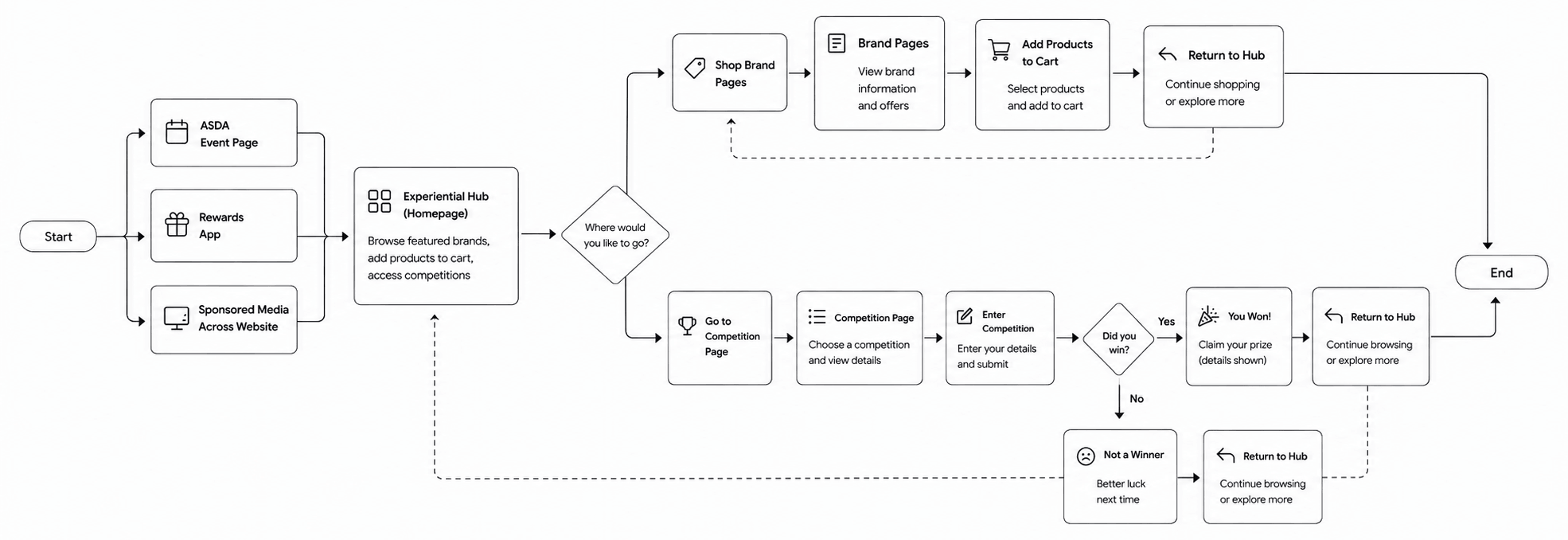
Once the pilot had proved the idea, the job changed from designing a page to designing something that could run every season. I mapped a cross-channel user journey so that every entry point, whether a seasonal event page, sponsored media or the Asda Rewards app, led to a consistent experience. The journey had to support different intentions, from browsing products to entering the competition.
Cross-channel journey showing how customers reached the hub from across the Asda ecosystem, including the Rewards app.
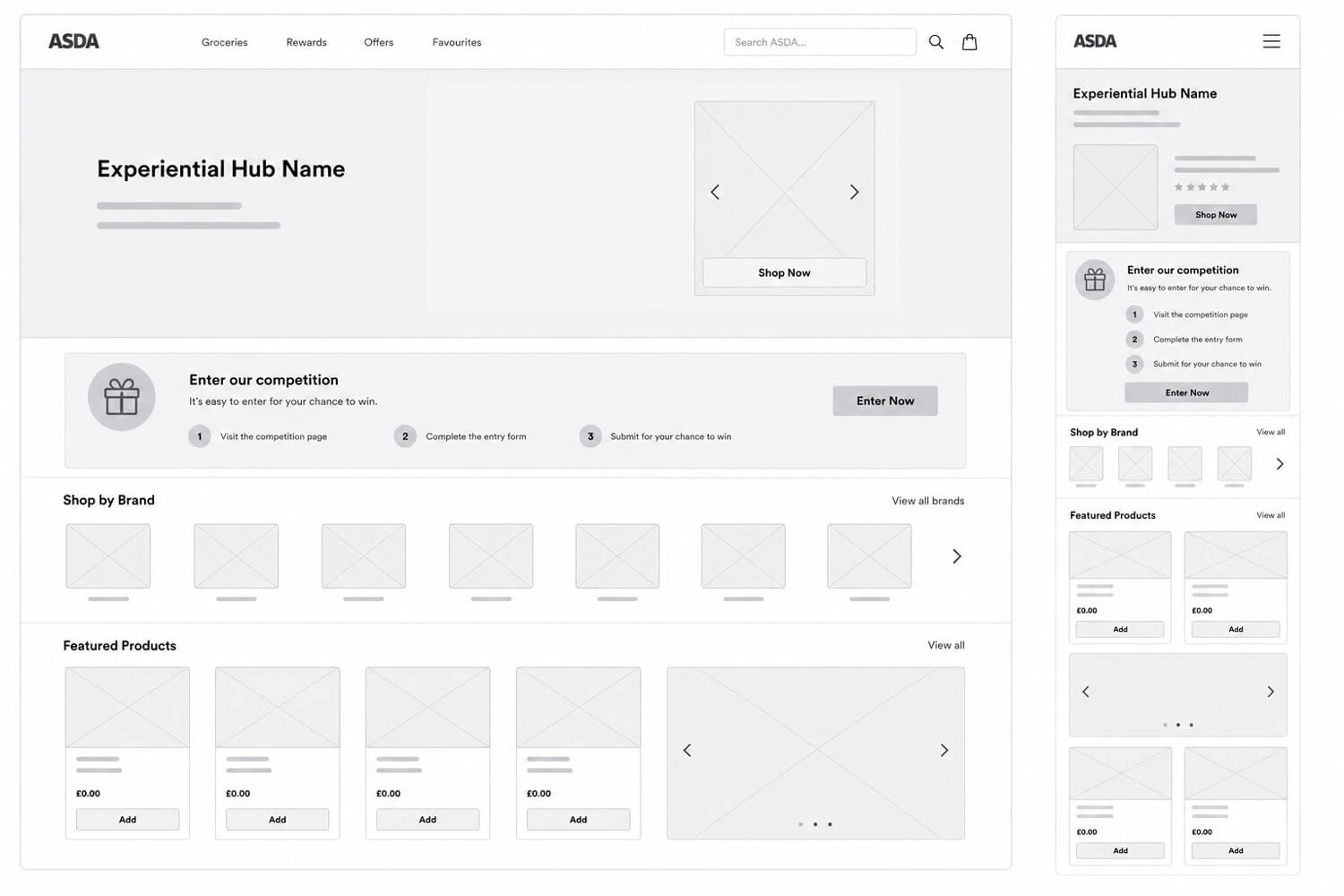
I then produced responsive desktop and mobile wireframes to agree layout, navigation and campaign structure with senior stakeholders and supplier teams. These became the template for multi-funded hubs, so each new event started from a tested structure instead of a blank page, with fewer rounds of changes.
Desktop and mobile wireframes created in Figma and presented to senior stakeholders for sign-off.
Each event kept the same structure but refreshed the competition. The Coronation's "Find the Winning Window" became a spin-to-win game for Big Night In, "find the winning gift" for Christmas, where hub brands sponsored the gifts for extra exposure, and "find the winning envelope" for Lunar New Year. Prizes moved to Asda Rewards Cashpot, which tied the hubs more closely to the Rewards app.
The template went on to run across Asda's major events, including Easter, Summer, Christmas, Big Night In and Lunar New Year.
Impact · Outcomes
Results
Experiential Hubs became a regular, standalone product for major FMCG suppliers, and opened up a new revenue stream from brands that couldn't justify a full Branded Zone. Big Night In, with 26 suppliers taking part across the event, drew over 910,000 competition entries. The Lunar New Year hub went further, with over 1.1 million entries, 25% more than Big Night In, with nearly a million clicks coming from the Asda Rewards app, plus strong traffic from email and social.
1.1M+
competition entries on the Lunar New Year hub
+25%
more entries than the Big Night In hub
~1M
clicks from the Asda Rewards app
"Just wanted to say that I (and the team) really love this Lunar New Year activation that is live and we are really pleased to be a part of it! It looks amazing & we would be eager to take part in future activations like this!"
Account ManagerMars
Reflection · Next Steps
What I Learned
The format worked because it was designed around what each group could realistically give. Suppliers only had to provide products and assets, Sales had something new to sell, and senior management got consistency through a shared template.
Success was mostly measured in entries and clicks, and we compared one event with the next. If I picked it up again, I would:
A/B test variations of the competition mechanic and hub layout within the same event, so we knew what was actually driving results.
Track what happened after entry, such as product views and basket adds, not just competition entries.
Give suppliers clearer reporting on how their products performed within each hub.
Looking for the bespoke single-brand pages? Branded Zones has its own case study.